No products in the cart.

Special Offer: Get 10% off all Offline Courses! Limited time only.
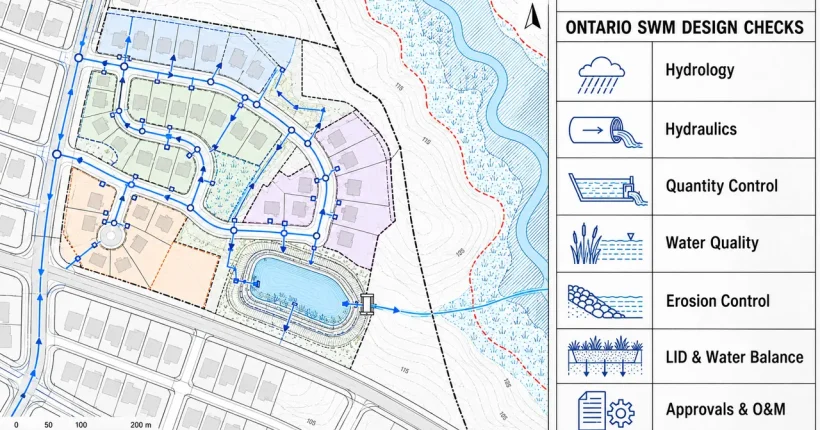
Quick answer: Choose a stormwater management course that connects site investigation, rainfall and runoff analysis, quantity and quality control, low impact development, water balance, grading, servicing, and erosion and sediment control in one coherent project workflow. Before enrolling, verify the calculations you will practise, the deliverables you will prepare, the instructor’s relevant experience, the software requirements, the applicable local limits, the support provided, and the total cost.
Updated October 2026.
“Stormwater management” can describe very different jobs. A land-development designer may need pre- and post-development runoff calculations, storage sizing, grading coordination and municipal submissions. An environmental or geotechnical professional may focus more on infiltration testing, groundwater constraints, water balance and source controls. Construction staff may need erosion and sediment control, inspection and maintenance knowledge. Define your target workflow before comparing course titles.
A practical course can introduce key concepts, but it cannot replace all prior engineering knowledge. Ask whether the course assumes familiarity with basic hydrology, drainage terminology, site plans, spreadsheets or CAD drawings. Learners without an engineering background may need additional foundation study. Learners who already prepare civil drawings should confirm whether the course goes beyond definitions and includes calculations, design decisions and coordinated deliverables.
A useful curriculum should show how early site information affects later design decisions. Existing topography, soils, infiltration, groundwater, outlets and local criteria influence drainage areas, runoff estimates, storage, conveyance, treatment and LID feasibility. Isolated lectures on individual topics are less valuable than a workflow that explains these dependencies.
| Area | Evidence to look for |
|---|---|
| Site investigation | Topography, land use, soils, boreholes, groundwater, outlets, utilities and constraints |
| Hydrology | Drainage areas, design storms, IDF information, time of concentration, hyetographs and hydrographs |
| Quantity control | Pre- and post-development comparison, peak-flow control, storage, release rates and major/minor systems |
| Quality and LID | Pollutant objectives, treatment devices, infiltration feasibility, source controls and winter operation |
| Water balance | Existing and proposed conditions, infiltration, evapotranspiration and reuse assumptions |
| Deliverables | Calculations, drainage plans, grading/servicing coordination, ESC plans and a structured report |
Canada does not have one universal stormwater design manual that automatically governs every project. Requirements can vary by province, municipality, conservation authority, watershed, receiving system and approval agency. A responsible course should teach how to identify and interpret applicable criteria rather than present one template as valid everywhere. Ask which jurisdictions are used in examples and when the material was last reviewed.
“Practical” should mean more than watching an instructor solve examples. Ask whether you will delineate drainage areas, calculate runoff or hydrographs, compare pre- and post-development conditions, evaluate quantity and quality controls, review LID feasibility, complete a water balance, and assemble drawings or report components. Confirm whether practice files, answer keys, instructor feedback or project review are included.
Stormwater courses may use spreadsheets, GIS, CAD, Civil 3D, EPA SWMM, PCSWMM, MIDUSS, HEC-HMS or proprietary tools. Software is not a substitute for understanding assumptions and results. Confirm which tools are demonstrated, whether licences are included, what computer specifications are required, and whether the course teaches model interpretation and quality checks—not only button sequences.
Look for relevant project or teaching experience and a clear explanation of professional boundaries. Training can build knowledge and workflow skills, but it does not authorize a learner to provide engineering services, replace a professional licence, or remove the need for project-specific review. Be cautious of guaranteed-job claims, universal design templates or promises that a short course alone makes someone fully qualified.
Check the language of instruction, access period, class size, update policy, technical support, software costs, taxes, payment-plan fees, refund terms and what the certificate actually represents.
BackToSkill’s Stormwater Management & Site Development course is organized as 10 practical sessions covering site investigation, hydrological calculations, design storms, infiltration and groundwater monitoring, pre- and post-development conditions, quantity and quality control, LID, water balance, grading and servicing plans, and erosion and sediment control. Review the current course page for delivery format, price, access and enrollment conditions before purchasing.
No. Stormwater training focuses on hydrology, hydraulics, drainage criteria, controls and design decisions. Civil 3D training focuses on CAD-based civil modelling and drawing production. The skills can complement each other, but one does not replace the other.
That depends on the course level and your goal. Technicians, designers, students and project staff can benefit from stormwater training, but advanced design responsibilities may require deeper engineering education, local experience and professional supervision.
No. A course certificate documents training only. It is not a professional engineering licence and does not replace provincial licensing requirements, employer competency checks or project-specific professional review.
Start with the gap that limits your work. If you understand hydrology but cannot operate the required model, software training may help. If you can run software but cannot evaluate assumptions, criteria or results, prioritize design principles and quality control.



Not a member yet? Register now
Are you a member? Login now