
A stormwater management plan can look convincing on paper and still fail at the site boundary. A calculated storage volume does not tell you whether the outlet is available, where water goes during an extreme event, or whether a proposed infiltration feature will work through a Canadian winter. For land-development projects, resolve these seven questions while the layout is still flexible.
1. Which local rules and approvals actually govern this site?
There is no single stormwater target for all of Canada. Start with the municipality’s current engineering standards, the applicable provincial requirements, the receiving watershed or conservation authority where relevant, and any site-specific approval conditions. Confirm the limits of the study area, allowable discharge, water-quality and water-balance objectives, and who owns the downstream outlet. Toronto, for example, sets out runoff, flood-management, water-quality and water-balance objectives in its Wet Weather Flow Management Guidelines. That is an example of a local framework, not a template to copy into another municipality.
2. What rainfall and snowmelt cases should be tested?
Identify the current intensity-duration-frequency (IDF) data and design storms accepted for the project location. The federal short-duration rainfall IDF dataset is a useful starting point, but the approving authority may prescribe different inputs or climate-change allowances. Compare more than a single peak-flow number: runoff volume, timing, major-system flow and sensitivity to assumptions matter too. In colder regions, snow storage, meltwater and rain-on-snow conditions can affect how a site drains and how controls operate.
3. Where can the water leave the site?
Trace the existing and proposed drainage areas to a real receiving point. Check outlet elevation, downstream capacity, tailwater, easements and maintenance access before committing to a pond, tank or LID practice. A design that meets a calculated release rate can still back up if the outlet is submerged or unavailable. Show the major overland flow route and the receiving path when the minor system is exceeded; do not assume excess water will harmlessly disappear at the property line.
4. Is infiltration credible at this location?
Do not choose a rain garden or infiltration trench solely because it fits on a concept plan. Review soil and infiltration testing, seasonal groundwater, bedrock, contaminated land, utility clearances and available drawdown time. Pretreatment and a defined overflow are part of the concept. The Ontario Stormwater Management Planning and Design Manual notes winter and spring limitations for infiltration facilities used as water-quality treatment. Local guidance and site testing should determine whether infiltration is appropriate.
5. Will winter operations change the drainage strategy?
Snow piles can block inlets, occupy storage, or redirect flow during thaw. Road salt and sediment create water-quality and maintenance concerns; freeze-thaw can alter surface performance. Keep snow-storage locations, access for cleaning, pretreatment and a winter overflow route visible on the grading plan. The point is not to reject LID in cold climates, but to design for how the site will actually be operated.
6. Can grading, utilities and stormwater controls coexist?
Set aside space for controls before the road and building footprints consume it. Check finished-floor elevations, accessible routes, retaining walls, underground services, fire access, property setbacks and construction sequencing. A swale that looks adequate in isolation may be flattened by an accessible crossing or severed by a utility trench. Coordinate the civil, landscape, geotechnical and environmental inputs early enough to adjust the layout.
7. Can another engineer follow the design and maintain it?
Document the existing and proposed drainage plans, rainfall sources, assumptions, model inputs, control sizing, outlet details, emergency overflow and expected inspection and maintenance. Show which items were measured, which were assumed, and which require confirmation. Keep the before-and-after comparison, but use it as evidence for design decisions rather than the whole story.
These checks are an educational workflow; approval criteria must be confirmed for the specific site and jurisdiction. In our Stormwater Management and Site Development course, ten practical sessions connect site investigation, hydrology, water balance, LID, erosion control and a traceable SWM report.
Need help working through a stormwater design challenge?
If you are unsure how to approach an approval criterion, outlet constraint, grading conflict or winter operation, email the specific question to support@backtoskill.com. The BackToSkill team can direct you to relevant learning material. Our Telegram channel and Facebook page are additional places to follow the learning community and exchange practical experiences with other learners. Use these resources to strengthen your professional design skills; project-specific engineering decisions and approvals remain with the responsible professionals.
You May Also Like
-
Oct 2, 2026
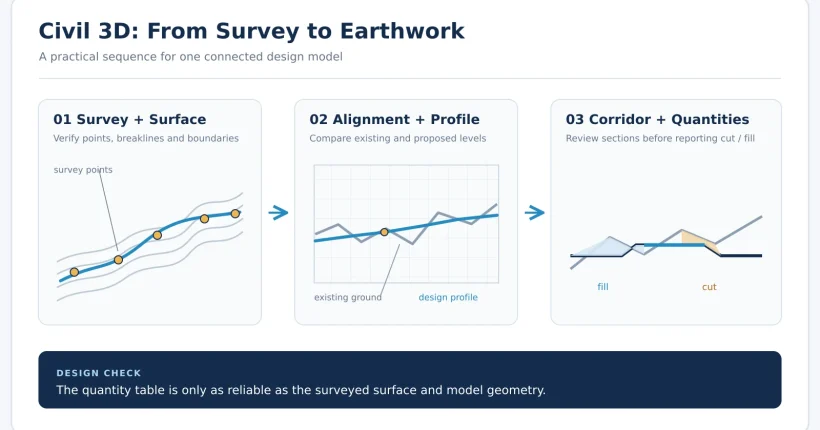
Follow a practical Civil 3D workflow through survey points, surfaces, alignments, profiles, corridors, cross sections and earthwork checks.